
2026
The technological developments recognized by INVAP improve cancer surgeries and reduce the costs of radiation measurement and digital X-ray systems.
The results of INVAP’s National Contest for the Engineering Theses were announced today, highlighting the Argentine technology company’s commitment to local talent. The fourth edition achieved record participation, further consolidating the growth of this nationwide initiative. A total of 184 theses were submitted in response to this call for applications, developed by 248 students from public and private universities located in different provinces of Argentina.
The winning projects focus on an intraoperative tumor detector for laparoscopic surgery and the development of low-cost X-ray systems using smartphone cameras.
The award-winning theses were developed using national technology and meet the objective set by INVAP in the context of its 50th anniversary. The company highlights applied research projects in the engineering universe with a plurality of perspectives. On Friday 23, the awards ceremony for the contest —supported by INVAP Foundation, which offers 10 million pesos in prizes— was held at INVAP’s headquarters in Bariloche.
INVAP’s General Manager, Engineer Darío Giussi, expressed his gratitude to the participants, jury members and institutions involved. Besides, he highlighted that “these awards are individual, but the achievement is due to collective work.” Giussi also stated that “for 50 years, we have been fostering the talent we have in this country.” That is why this commitment to knowledge, science, and hard work is the result of the perseverance of those who develop appropriate public policies and of those of us who contribute to ensuring that Argentina remains a great country, with our contributions reaching the world.
Participation in the fourth edition of INVAP’s National Contest “Best Engineering Theses” increased by over 40% since its first call for applications. This year, we received 184 theses from 54 institutions, developed by 248 students from 22 provinces and districts. One of the theses submitted was defended from the Argentine Antarctica.
The winners
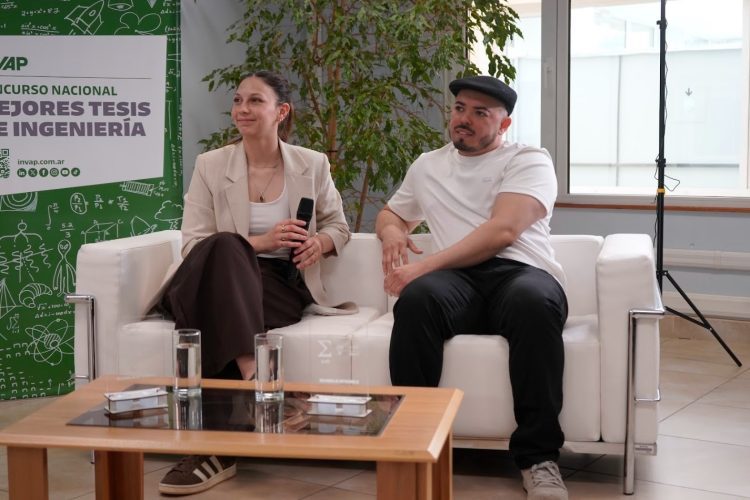
In the Undergraduate category, the winner is Lara Agostina Torletti Daniluk, Electronic Engineer from the National University of Río Negro. Her development, Gamma Tracker, is a smart, portable medical probe that enables real-time localization of tumors during laparoscopic surgeries.
The device is designed to guide surgeons in real time in locating and removing tumors with precision during minimally invasive surgery. This Argentine-developed technology, whose patent application has already been filed, promises to revolutionize cancer surgery by reducing the risk of disease recurrence and preventing the unnecessary removal of healthy tissue.
The probe combines gamma radiation-sensitive crystals, low-voltage silicon sensors, and tungsten shielding that reduces lateral interference by nearly 50 times. A console with a display and audible signals guides the surgeon in removing tumor tissue without affecting healthy areas. The prototype was validated using radioactive samples and tissue extracted during surgeries. “This is the result of a collective effort, involving professors and mentors who were always there to support me,” she said visibly moved.
In the Doctorate’s category, Damián Leonel Corzi, from the Balseiro Institute’s PhD in Engineering Sciences, was awarded. He conducted research on how to transform conventional digital cameras into sensors capable of detecting radiation. Using this large-scale technology, he developed a portable radiation detector, with Wi-Fi connectivity, to capture high-resolution X-rays and reconstruct three-dimensional images. This tool, which is affordable and accessible to everyone, offers a lower-cost alternative to conventional scientific detectors, with potential applications in veterinary medicine, agronomy, the electronics industry, and environmental safety.
Thus, the project helps capture invisible radiation while preventing images from appearing blurry or distorted. Besides, a method was developed to combine together multiple images taken around an object and create its internal 3D model. “This contest shows society that the country is in need of engineering and development. I come from the Islas Malvinas neighborhood in La Rioja, and winning this award reflects a collective decision —that of the many people who supported me, as well as the commitment to upholding public universities,” he emphasized.
A growing contest
Compared with the inaugural edition, held in 2023, the number of participants increased by 41.7%, while the number of theses grew by 32.4%. The contest also expanded its geographic reach: participating provinces rose from 16 to 22, while represented institutions increased from 39 to 54, reflecting broader participation by universities and academic institutions from across the country.
Female participation also continued to grow steadily, standing out as one of the most significant milestones of this edition. This year, women accounted for 37% of all participants, a one-third increase compared to the first call for applications.
The jury
The jury was made up of a team of professionals with extensive experience in different branches of engineering, physics, energy and the technology industry: Guillermo Benito (Nuclear Engineer graduated from the Balseiro Institute, a leading figure in INVAP’s Space Area); Graciela Ciccia (Ph.D. in Pharmacy and Biochemistry from the University of Buenos Aires —UBA, in Spanish— and Executive Director of the Argentine Chamber of Biotechnology); Pedro Napoletano (Electromechanical Engineer and Director of Engineering at Techint E&C); Julián Isaac (Mechanical Engineer with a postgraduate degree in Oil and Gas Production; he is currently Process Optimization Manager at Pan American Energy); Franco Alcaraz (Electrical Engineer with a Master’s degree in Engineering, specializing in Artificial Intelligence); Roxana Cocco (Materials Engineer graduated from the National University of Mar del Plata —UNMDP, in Spanish— and PhD in Materials Science and Technology); Verónica Garea (Nuclear Engineer with a PhD in Engineering Physics); Ana Caumo (Electronic Engineer graduated from the National University of La Plata —UNLP, in Spanish—, Senior System Engineer at INVAP) and Eduardo Nassif (Lic. in Physics from the UBA and PhD in Physics from the UNLP).
+info
Download photos here

